Mount Sinai Camel Path vs Steps of Repentance: Which Route?
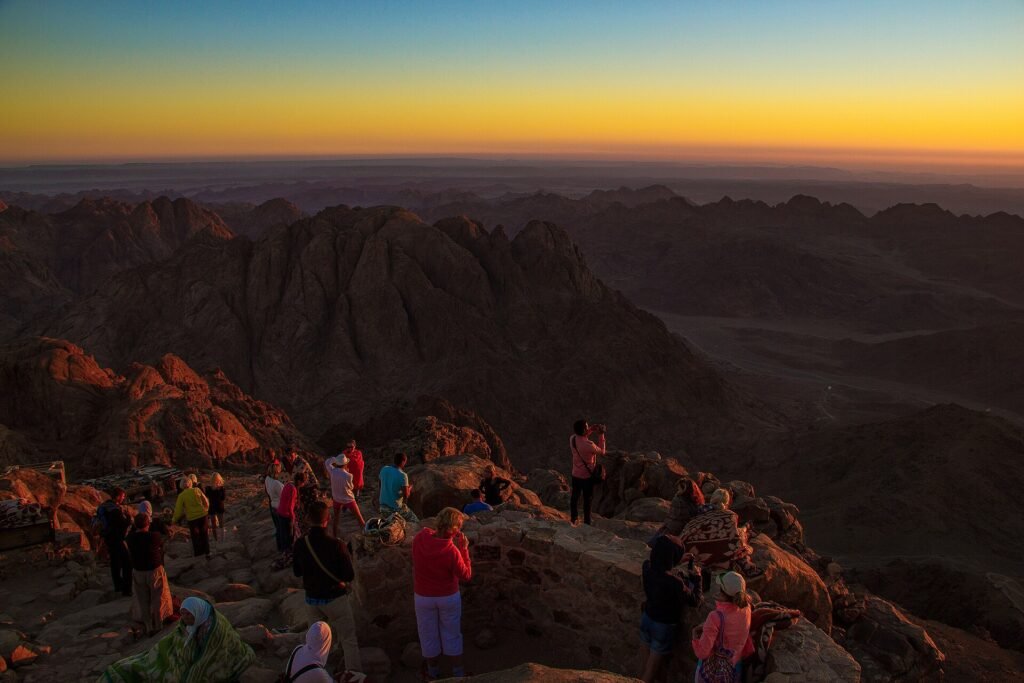
Mount Sinai has two walking routes from St Catherine’s Monastery to the top. The Camel Path is longer, wider and gentler, and you can hire a camel for part of the way. The Steps of Repentance are about 3,750 stone steps: shorter, steeper and harder on the knees. If you are choosing between the camel path Mount Sinai guides use at night and the steps, the usual answer is simple: go up the Camel Path in the dark and, if your knees allow, come down the steps in daylight.
Both routes meet at Elijah’s Basin, a small plateau below the summit, and from there everyone climbs the last 750 steps on foot. This guide covers each route step by step, how the camels work, where the tea huts are, and how to decide what suits you. For the bigger picture (visas, what the summit is like, the monastery), read our Mount Sinai hike guide. If you want to go from Dahab, our Mount Sinai sunrise trip with St Catherine picks you up at your hotel at 22:00 and gets you back around 11:00 the next morning.
The Two Mount Sinai Trails at a Glance
Mount Sinai (Jebel Musa) stands at 2,285 m. St Catherine’s Monastery, where both routes start, sits at about 1,586 m, so you climb roughly 700 m in height whichever way you go. What changes is how that height is spread out.
| Camel Path | Steps of Repentance | |
|---|---|---|
| Local name | Siket El Basha | Siket Sayidna Musa (Path of Moses) |
| Start | Along the northern wall of the monastery | The ravine behind the monastery |
| Surface | Wide gravel track with switchbacks | Rough, uneven stone steps cut into a ravine |
| Gradient | Gradual | Steep most of the way |
| Steps | None until Elijah’s Basin, then the final 750 | About 3,000 to Elijah’s Basin, then the same final 750 |
| Camels | Yes, up to Elijah’s Basin | No |
| Good in the dark? | Yes, with a torch and a guide | Not recommended |
| Best use | Going up at night | Coming down in daylight |
Published figures put the full walk at about 7 km out and back, and the round trip at roughly 4 to 6 hours including time at the top. On a sunrise climb, plan on about 2.5 to 3 hours up and 1.5 to 2 hours down, with 30 to 45 minutes on the summit. These are averages; your pace, the crowd and the weather all change them, so check before you go.
Camel Path Mount Sinai Route, Step by Step
The Camel Path is the route most sunrise groups use on the way up. It was made wide enough for camels, so it zigzags up the mountain at an easy angle instead of going straight up. It is longer than the steps, but most people find it far less tiring.
From the monastery to the first switchbacks
You start in the car park area below St Catherine’s Monastery and walk past the monastery walls. Lonely Planet describes the trail as following the northern wall and continuing beyond the end of the compound. This is where the camel handlers wait, and where you will hear the first offers of a ride.
The first part is the easiest stretch: a wide path of packed gravel and sand climbing slowly up a valley. Keep your own pace and let faster groups pass.
The middle section and the tea huts
Higher up, the switchbacks get tighter. Bedouin huts along the path sell tea, coffee, soft drinks and snacks, and many rent blankets.
Watch your footing on loose gravel, especially on the bends. Camels use the same path, so step to the inside of the trail (away from the edge) when one passes, and do not walk directly behind a camel.
Elijah’s Basin
The Camel Path ends at Elijah’s Basin, a small plateau linked in tradition to the prophet Elijah. Lonely Planet notes an old cypress tree there and basic composting toilets. This is where camel riders get off, where the Steps of Repentance join from the other side, and where you get ready for the last part.
Take a short break here. Put on your warm layer before you start the final steps, not after, because you will stop moving at the top and the wind hits hard.
Steps of Repentance: The Steep, Direct Route
The Steps of Repentance (also called the Steps of Penitence) are the older way up. Tradition says they were cut by monks. The route climbs a ravine directly behind the monastery, so it is shorter on the map but much steeper underfoot.
What the steps are like
Do not picture a staircase. The steps are rough granite blocks, uneven in height and width, and some are knee-high. On the way down you need to watch every step.
Lonely Planet counts about 3,750 steps in total: around 3,000 from the monastery to Elijah’s Basin and then 750 to the summit. UNESCO’s description of the site mentions stone gateways on this path, including the Gate of Stephen and the Gate of the Law, as well as the remains of small chapels.
Why the steps are a poor choice at night
Lonely Planet advises against the Steps of Repentance in the dark. Uneven steps, a narrow line and only a head torch for light make slips more likely. Going up the steps also tires your legs before the final 750, which you have to climb anyway.
In daylight it is a different walk. The lower part of the steps gives views straight down onto the monastery and the valley, which you never see from the Camel Path. That is why many walkers who have the knees for it come down this way.
The Final 750 Steps to the Summit
Whichever path you take, the last part is the same: about 750 steep, uneven stone steps from Elijah’s Basin to the top. There is no camel option here. Everyone walks.
For most people this is the hardest part of the night. Take short steps, use your hands on the rocks if it helps, and stop when you need to. There is no prize for arriving first.
At the summit you will find a small Greek Orthodox chapel and a small mosque. Both are usually locked. The chapel was built in 1934 on the ruins of a 16th-century church. Huts near the top sell hot drinks and rent blankets for the wait.
Camels on Mount Sinai: How It Works
Bedouin camel handlers wait near the start of the Camel Path. You can hire a camel for part of the way up, and the ride ends at Elijah’s Basin. The ride is agreed directly with the handler and is not included in our trip, so ask your guide how it works on the night.
Riding up vs riding down
Riding up is easier on the body than riding down, as Lonely Planet points out. Going downhill, the camel pitches forward with every step and you have to brace yourself the whole time, often on narrow bends in the dark or early light. If you hire a camel, use it for the way up and walk down.
Staying safe on a camel
- Hold the saddle handle with both hands when the camel stands up and kneels down. The movement is sudden and comes in two jerks.
- Keep your bag light and fastened. A heavy backpack pulls you off balance.
- Tell the handler if you want to stop or get off. You can walk the rest at any point.
- Wear warm clothes. You do not generate heat sitting on a camel, and you will feel the cold more than walkers.
Which Route Up and Which Down?
The common plan on a sunrise climb is the Camel Path up in the dark and the Steps of Repentance down in daylight. You get the even gradient when you cannot see much, and the views of the monastery when you can.
When to come down the Camel Path instead
Use the Camel Path Mount Sinai route both ways if any of these apply to you:
- You have knee, hip or ankle problems. The steps put heavy load on the knees going down.
- You are walking with children or older family members who are already tired after the summit.
- You are not confident on uneven ground or have poor balance.
- It has rained, snowed or frozen. Wet or icy granite steps are slippery.
When the steps make sense going down
If your knees are fine and you want the views over the monastery, the steps are the better descent.
On an organised trip the guide chooses the way down based on the group and the conditions. If you have a strong preference, ask when you book which descent the group usually takes.
Is It Hard? Knees, Children and Older Walkers
You do not need hiking experience for Mount Sinai. Normal fitness is enough for most people. The difficulty is the time of night, the cold, the final 750 steps and the descent, not technical climbing.
Knees
The descent is what hurts knees, not the climb. Walking poles help. Take the Camel Path down if you have any knee trouble, shorten your steps, and do not rush. A light knee support is worth packing if you already use one at home.
Children
It is a long night for children: a 22:00 pickup, a night drive and a 1:00 or 2:00 start. Bring an extra warm layer, plenty of snacks, and a plan to turn back at a tea hut if they are done. Ask on WhatsApp before booking whether the trip suits your child’s age.
Older walkers
Some older travellers reach the top by taking a camel to Elijah’s Basin and walking the final steps slowly. Walking down the Camel Path is the safer descent. If you have heart or lung conditions, talk to your doctor before booking an overnight climb.
What to Bring for the Night Climb
The summit is cold before dawn in every season, and the wind makes it feel colder. Lonely Planet describes the top as cold and windy even in summer, with light snow common in winter. Exact summit temperatures change night to night, so check the forecast for St Catherine before you go and pack for colder than that.
- Warm layers: a proper jacket, a fleece or sweater, a hat and gloves. In winter, add thermal layers.
- Head torch: keeps your hands free on the path and the steps.
- Walking shoes: trainers with a good grip or light hiking shoes. No sandals.
- Water and a snack: huts sell drinks and food, but carry your own as well.
- Cash in small notes: for tea, blankets, toilets, and a camel if you want one.
- Passport: you need it at police checkpoints on the road. You also need a full Egypt visa, because the free Sinai-only entry stamp does not cover St Catherine.
- Modest clothes for the monastery: shoulders and knees covered if you plan to visit afterwards.
Sunrise Timing by Season
Sunrise at St Catherine moves through the year. Clock times also jump by an hour because Egypt uses summer time (in 2026 from 24 April to 29 October, according to sunrise tables). For 2026, those tables give the earliest sunrise as about 5:10 in late April, just before the clocks go forward, and the latest as about 6:50 in late October, just before they go back. Check the exact time for your date before you go.
The sky starts to lighten well before the sun appears, so aim to be at the top a little early. Walkers who are slow on the final steps should start up them in good time rather than rush.
For which months are best for the climb overall, see our guide to the best time to visit Dahab.
The Night Trip from Dahab
Most visitors in Dahab do Mount Sinai as a night trip. There is no need to stay overnight in St Catherine. Here is how our trip runs:
- 22:00: pickup at your hotel anywhere in Dahab.
- Night drive to St Catherine, with police checkpoints on the way. Keep your passport handy.
- Around 1:00 to 2:00: start walking with a Bedouin guide.
- About 2.5 to 3 hours up, with stops at tea huts and at Elijah’s Basin.
- Sunrise at the summit, then 30 to 45 minutes at the top.
- Walk down past St Catherine’s Monastery, about 1.5 to 2 hours.
- Around 11:00: back at your hotel in Dahab.
Hotel transfers, the Bedouin guide and the protectorate entry ticket are included; tips are not. You can check the times, what’s included and the current price on the Mount Sinai sunrise trip page and book there on WhatsApp. You pay in cash on the day.
After a night on the mountain, plan an easy day. Our Dahab itinerary for 3, 5 or 7 days shows how to fit the climb into a short stay without stacking early starts. Other evening and sunrise options are listed under night and sunrise trips from Dahab, and you can see everything else on the full list of Dahab trips.
A Few Things Worth Knowing Before You Go
A guide is required
You cannot simply walk up alone. Climbing Mount Sinai requires a local Bedouin guide, which is arranged as part of any organised trip.
The mountain is a protected and sacred site
Mount Sinai sits inside the Saint Catherine Area, a UNESCO World Heritage Site, and the wider St Katherine protectorate. The mountain is sacred to Jews, Christians and Muslims, so dress modestly, keep your voice down at the summit, and take your rubbish back with you.
How high is it, really?
Mount Sinai is 2,285 m, but it is not Egypt’s highest mountain. That is Mount Catherine, a few kilometres to the south. Our article on Mount Sinai’s height and Egypt’s highest mountains explains the difference and what the height means for the climb.
Trips in this guide
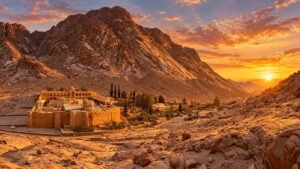 Mount Sinai Sunrise + St. CatherineA night hike up Mount Sinai for sunrise, then down past St Catherine’s Monastery.See the trip Mount Sinai guideThe night climb, sunrise at the top and St Catherine’s Monastery.Read the guide
FAQ
Is the Camel Path Mount Sinai route easier than the steps?
Yes. The Camel Path is longer but has a gentle, even gradient and a wide surface, so most people find it much easier, especially at night. The Steps of Repentance are shorter but steep and uneven. Both routes end at Elijah’s Basin, and from there everyone climbs the same final 750 steps to the summit on foot.
How many steps are there on Mount Sinai?
The Steps of Repentance have about 3,750 stone steps in total: around 3,000 from the monastery to Elijah’s Basin and about 750 from Elijah’s Basin to the summit. If you take the Camel Path, you still climb those final 750 steps. They are rough and uneven, not a regular staircase, so take them slowly.
Can a camel take me all the way to the top?
No. Camels go up the Camel Path as far as Elijah’s Basin. The last 750 steps to the summit are too steep for animals, so everyone walks that part. It is better to ride up than down, because riding a camel downhill is uncomfortable and less stable. You agree the camel ride directly with the handler at the start.
Which Mount Sinai route is best for going down?
If your knees are good, the Steps of Repentance are the more interesting descent, with views over St Catherine’s Monastery in daylight. If you have knee trouble, are tired or are with children, take the Camel Path down again. It is longer but much gentler, and safer when the ground is wet or icy.
How long does the Mount Sinai hike take?
On a sunrise climb, plan on about 2.5 to 3 hours up, 30 to 45 minutes at the top, and 1.5 to 2 hours down. Pace, crowds and stops at the tea huts all change this, so treat these as averages and check before you go. From Dahab, the full night trip runs from a 22:00 pickup to about 11:00.
Do I need a visa for the Mount Sinai hike?
You need a full Egypt visa. The free Sinai-only entry stamp does not cover St Catherine or Mount Sinai. Carry your passport on the trip, because there are police checkpoints on the road. Visa rules can change, so check the current rules before you travel.
More Dahab guides
 How high is Mount Sinai?The height, the climb and how it compares with Egypt’s other peaks.Read the guide
 Dahab itinerary: 3, 5 or 7 daysDay-by-day plans that mix the sea, the desert and Mount Sinai.Read the guide
Photo credits
- Walkers waiting for sunrise on the summit of Mount Sinai — Ahmedherz, CC BY-SA 4.0
- A white day boat moored off the coast of Dahab, with the mountains behind — Grand Parc – Bordeaux, France, CC BY-SA 2.0