Dahab Beaches: Where to Swim, Relax and Snorkel From the Sand
The best Dahab beach depends on what you want from the day. For soft sand and flat, shallow water, go to the Lagoon at the south end of town. For coral a few metres from your towel, use the Lighthouse or Eel Garden in town, or the Blue Hole beach to the north. For a quiet bay with no road at all, go to the Blue Lagoon in Ras Abu Galum. Most of the shore in Dahab is reef rather than long sandy beach, so knowing where to get in matters more than in most seaside towns.
This guide covers each beach by area: what the entry is like, how windy it gets, where the shade and cafés are, how you get there and who it suits. It also covers what to wear, beach rules and safety on a reef coast.
Some beaches have no road. The Blue Hole, Abu Galum and Blue Lagoon day trip takes you from the Blue Hole beach by zodiac to the Blue Lagoon; you can also walk or ride a camel there along the shore trail. On the trip page you can check the time, what’s included and the current price, and book there on WhatsApp.
Dahab beaches at a glance
The coast runs roughly north to south. The town beaches sit along the promenade in the middle, the Lagoon is at the southern end of town, the Blue Hole and Abu Galum are to the north, and Three Pools and Wadi Gnai are to the south. Ras Shitan is a longer drive north, near Nuweiba. To see Ras Shitan with transport and a guide, there is our Wadi Weshwash and Ras Shitan trip from Dahab.
| Beach | Area | Getting in | Water and wind | Shade and cafés | How to get there | Suits |
|---|---|---|---|---|---|---|
| Lighthouse | Town, north of the bridge | Small beach, gravel shallows then seagrass and reef | Usually busy | Cafés and sunbeds right on the sand | Walk along the promenade | First-time snorkellers, people who want cafés nearby |
| Masbat and Mashraba | Town centre and south of the bridge | Gravel and reef; use the marked entries | Gets choppy when the wind is up | Café seating with cushions along the water | Walk | A swim between meals, sunset drinks |
| Eel Garden and Assala | North end of the promenade | Swim over a shallow coral bed | Calm days only; sea urchins in the shallows | Fewer cafés than the centre | Walk | Confident swimmers who want a quieter spot |
| The Lagoon (Laguna area) | South end of town | Sand, no coral | Shallow and flat; steady wind most days | Hotel beaches and windsports centres | Short taxi, about 3.5 km south of Masbat | Paddling, families, windsurf and kite beginners |
| Blue Hole beach | About 10 km north | Reef wall a few metres from shore | Very deep water beyond the reef | Bedouin cafés with loungers along the shore | Taxi or a trip with transfers | Snorkellers, a long lunch by the sea |
| Blue Lagoon (Ras Abu Galum) | North of the Blue Hole, no road | White sand, shallow bay | Sheltered; kites sometimes out further | Simple Bedouin huts for shade | Boat, shore trail or camel | A quiet day away from town |
| Three Pools | South of town | Shallow lagoons inside the reef | Calm on still days; avoid when windy | Restaurants and a café nearby | Taxi or a trip with transfers | Beginners and families in calm weather |
| Wadi Gnai | Further south | Beach where a dry valley meets the sea | Depends on the day’s wind | Palm trees of the oasis | Beach buggy across the desert, or boat | People who want an empty stretch of coast |
| Ras Shitan | Near Nuweiba | Rocky, with pebbles and coral; reef shoes help | Usually small waves | Beach camps with huts and shade | Long drive north | A full day out with lunch on the beach |
How beaches work in Dahab
Dahab sits on the Gulf of Aqaba, and most of the coastline is fringing reef. The coral is very close to shore, so you can walk straight in, but only at the access points. Between those points the reef top is shallow and sharp, and it is easy to cut your feet or damage coral.
Sandy stretches exist, but they are the exception. The Lagoon is the main one in town, and the Blue Lagoon in Ras Abu Galum is the other well-known one. Most of the town beaches are small patches of sand or gravel in front of cafés, with the reef starting a short swim out.
The other thing that shapes a beach day is wind, which is why Dahab is a windsurfing and kitesurfing town. IKSurfMag describes wind on most days from March to November, and in winter a pattern of a few windy days followed by a few calm ones. On a windy afternoon the exposed town beaches get choppy, while the Lagoon stays flat. For how wind and sea temperatures change through the year, see our guide to the best time to visit Dahab.
Getting between beaches
The town beaches are all on the seafront walkway, so you can walk between the Lighthouse, Masbat, Mashraba and Eel Garden. The Lagoon is a short taxi ride south of the centre; Hostelworld puts it about 3.5 km from Masbat, so check before you go if you plan to walk it. For the Blue Hole, Three Pools and anything further out you need a taxi or a trip with transfers. Rules on town taxis going outside Dahab have changed over the years, so check before you go: ask your hotel to arrange the ride and agree the price first.
Beaches in town: the Lighthouse, Masbat, Mashraba and Eel Garden
The town beaches line the promenade that runs along the sea through Assala in the north, Masbat in the middle and Mashraba to the south. They are less about lying on sand and more about sitting at a café with the sea in front of you and swimming out to the reef when you feel like it.
Lighthouse beach Dahab
The Lighthouse sits just north of the bridge in the centre. Children, snorkellers, divers and sunbathers share a small section of beach here, and it is one of the easier places to get into the water in that part of town. Cafés, dive schools and sunbeds spill right onto the sand.
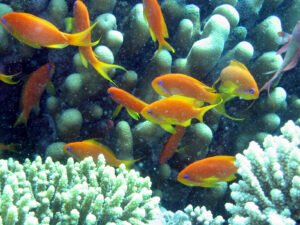
It is the most popular snorkelling spot in town and close to most of the dive centres, so divers share it with swimmers and groups go in and out. The shallows are gravel that deepens to a seagrass meadow before the coral reef, so it is an easy place for a first snorkel. For what you will see underwater at the Lighthouse, see our guide to Dahab snorkeling spots. If you want to dive rather than snorkel, our Dahab diving guide covers the dive sites and how to choose a dive centre.
Masbat and Mashraba: the promenade beaches
Masbat is the central tourist stretch, with the promenade, shops, restaurants and the bridge over the dry floodway. Mashraba, south of the bridge, is a calmer stretch with guesthouses and dive lodges. At Mashraba you get in across a gravel wash that leads to a seagrass meadow and then the reef. Along this part of the promenade the beaches are for swimming from the café rather than for lying on sand all day.
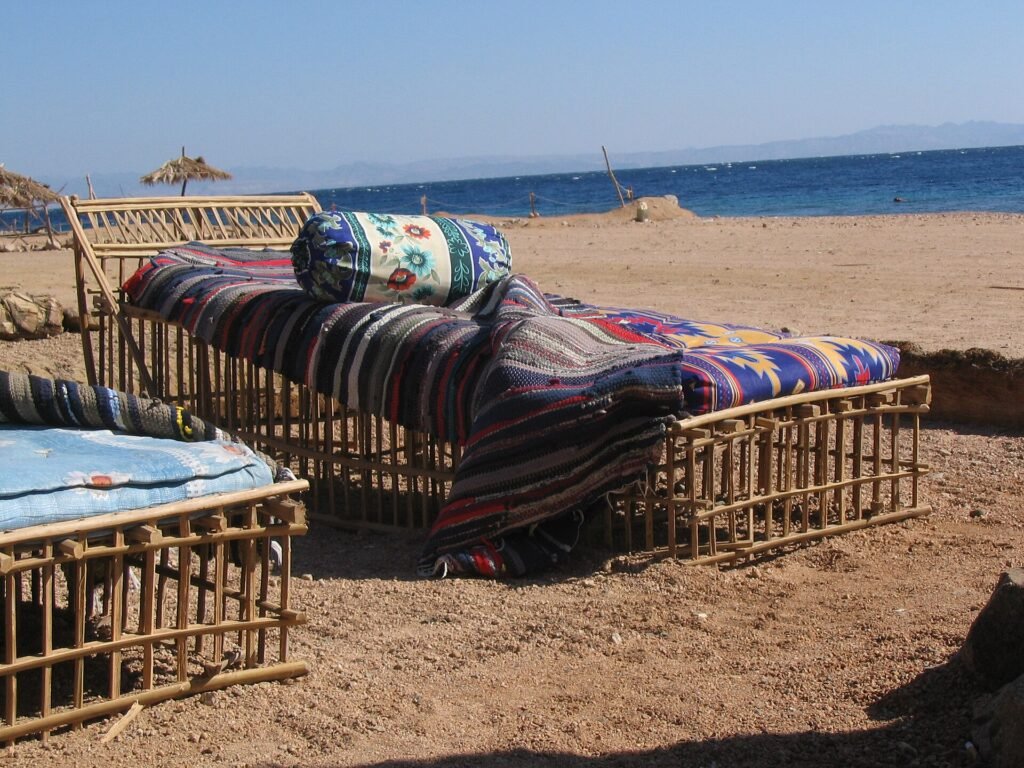
The main draw here is the seating. The seafront is lined with cafés where you sit on floor cushions with your feet almost in the water, with low tables set out on the sand along the Lighthouse and Masbat. It is the classic place for a late breakfast or a sunset drink between swims.
Eel Garden and Assala
Eel Garden is at the north end of the promenade, next to Assala, the original Bedouin village. It is quieter and more local than the centre, with fewer restaurants. To reach the reef you swim over a shallow coral bed with sea urchins, so it is best on calm days and for confident swimmers.
The water off Assala is also a kitesurf spot, but only for experienced riders. The IKSurfMag Dahab guide notes that the wind here blows onshore, so you need to be an advanced kiter to get off the beach, and recommends boots because of stones and coral. If you just want to swim, pick a calm day.
Café seating, sunbeds and what you pay for
There is usually no ticket to walk onto the town beaches from the promenade. The cushions, sunbeds and shade in front of the cafés are set out by the cafés themselves, so the usual approach is to order something. Arrangements differ from place to place and can change, so check with the staff before you settle in.
The same applies to hotel beaches. If a hotel’s beach is not obviously open to the public, ask at reception rather than assuming you can use it.
The Lagoon in the Laguna area: sand, flat water and windsports
The Lagoon is a wide, shallow bay at the south end of Dahab with flat water and steady wind. It is the main sandy beach in town, with no coral to step on, and the sheltered bay is good for small children paddling and for windsurfing. The area around it is called Laguna, also written Lagoona. Wikivoyage lists a separate Laguna Beach as a shallow snorkelling and beginner dive site, so check which one people mean when they say Laguna beach.
Swimming and paddling at the Lagoon
The water is shallow enough that you can stand up in most places, according to IKSurfMag, and the HIDMC windsurfing guide describes calm, waist-deep water. That makes it the easiest beach in town for non-swimmers and small children. For more on calm water and family days, see our guide to Dahab with kids.
The Lagoon is shared with windsurfers and kitesurfers, and boards come in fast. Swim and paddle away from where people are launching and landing, and keep children close to the shore.
The windsurfing and kitesurfing zone
The windsurfing and kitesurfing schools sit on the Lagoon, rent gear and give lessons, and the shallow water suits beginners because an instructor can stand close to you. IKSurfMag describes a kite lagoon next to the main kite centres for learning, and a larger area where advanced kiters launch from the public beach and stay downwind of the windsurfing area.
There are rules about who uses which part of the water. According to IKSurfMag, kiting is not allowed in the windsurfing area between 9:00 and 15:00; check before you go, as local rules can change. The wind at the Lagoon is cross-offshore, meaning it blows slightly away from the beach, so the same guide recommends storing your kit at a centre that runs a rescue service.
On wind through the year, the HIDMC guide says December to February brings gentler winds suited to beginners, while May to September brings stronger, steadier wind for experienced riders. Wind varies from day to day, so check the forecast.
Hotel beaches on the Lagoon
A few three- and four-star hotels sit on the main sandy beach next to the kite lagoon, and at least one dive centre is based on a hotel beach in the Lagoon area. If you stay here, your hotel beach may be your main beach for the trip. If you stay in town, a taxi to the Lagoon for an afternoon is short.
A night on the Lagoon
The Lagoon is also where Dahab Go runs Lagoon Night till Sunrise: a private Bedouin setup on the Dahab Lagoon with a fire, tea and music, from sunset until sunrise. It is for private groups and the price is on request. You can check what’s included on the trip page and ask there on WhatsApp.
North of town: Blue Hole beach, Abu Galum and the Blue Lagoon
The road north follows the coast past dive sites and ends just beyond the Blue Hole. After that, the coast continues into the Ras Abu Galum protected area, which has no road.
Blue Hole beach and the Bells
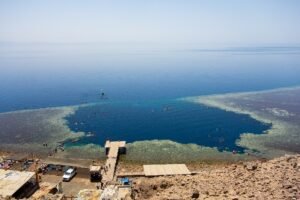
The Blue Hole is about 10 km north of town. It is a sinkhole in the reef more than 100 metres deep, and the reef wall starts a few metres from the shore, so you can snorkel straight from the beach. Just north along the shore is the Bells, a narrow groove through the reef that divers often combine with the Blue Hole.
As a beach, the Blue Hole is mainly a line of Bedouin cafés with loungers along the shore. Restaurants and shops along the beach sell food, drinks and souvenirs, and some cafés sit above the water. It can get crowded when excursion buses come up from Sharm el Sheikh, and the cafés are where people rest between swims. Entry to the Blue Hole area is a protectorate ticket paid on site in cash, so check the current amount before you go.
Ras Abu Galum and the Blue Lagoon
North of the Blue Hole, Ras Abu Galum is a protected area with Bedouin settlements, quiet reefs and no road. You reach it by boat, or on foot or by camel along the shore trail from the Blue Hole. The Blue Lagoon is a shallow bay further north with white sand, turquoise water, mountains behind and simple Bedouin huts for shade.
Past the Blue Hole there is no road, only Bedouin settlements and simple huts, so bring water, sunscreen and cash with you. Our full guide to Blue Lagoon Dahab and Ras Abu Galum covers the three ways in, staying overnight and what to bring.
The Blue Hole and Blue Lagoon trip runs 9:00 to 17:00. You snorkel the Blue Hole reef wall from the beach, take a zodiac north along the coast to Ras Abu Galum, and have free time at the Blue Lagoon. Hotel transfers, a guide, a snorkel mask and the zodiac ride are included; the Blue Hole entry ticket is paid on site in cash. Check the time, what’s included and the current price on the trip page, and book there on WhatsApp.
South of town: Three Pools and Wadi Gnai
South of Dahab the coast is quieter, with open desert running down to the sea. You need a taxi or a trip with transfers to get here.
Three Pools
Three Pools is south of Dahab, about 10 km from town according to Alternative Egypt; check before you go if you are arranging your own taxi. It has shallow lagoons inside the reef. The water inside is calm and the coral is close to shore, so on a still day it works for beginners and families who want to swim and look at fish without going far out. Wikivoyage warns that snorkelling along the reef can be hazardous when the wind gets up, so pick a calm day.
There are restaurants and a café nearby for food, drinks and shelter. Entry is a group ticket paid on site, so check the current amount before you go.
Wadi Gnai
Wadi Gnai is a palm oasis further south, where a dry valley meets the sea. There is no shore road, so you get there by buggy across the desert or by boat. That keeps it quiet: a strip of beach with palm trees behind it and not much else.
The Three Pools and beach buggy trip to Wadi Gnai runs 11:00 to 17:00. You snorkel at Three Pools first, then drive your own beach buggy through the desert to the Wadi Gnai oasis. Transfers, a beach buggy for two people and the snorkel stop are included; a solo buggy is possible for an extra fee, and the Three Pools group ticket is paid on site. Bring a scarf or buff against the dust. Check the time, what’s included and the current price on the trip page, and book there on WhatsApp.
Further away: Ras Shitan near Nuweiba
Ras Shitan is a rocky headland on the coast north of Nuweiba, on the stretch towards Taba. The coast here is lined with small, mostly Bedouin-run beach camps of reed huts with shaded seating and hammocks. 1001beach describes the beach as rocky, and Cairo 360 says the shore in front of one camp is mostly pebbles and coral, which makes swimming out tricky. Bring reef shoes.
The appeal is space and quiet. The Gulf of Aqaba is usually calm here with small waves, and the camps feel a long way from the cafés of Dahab. It is too far for a casual afternoon, so it works best as part of a longer day out.
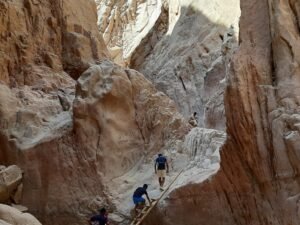
The Wadi Weshwash and Ras Shitan trip runs from 8:30 to about 18:00. A Land Cruiser takes you to Wadi Weshwash, a narrow granite canyon near Nuweiba with freshwater pools, where you walk in with a Bedouin guide and swim or jump only where the water is deep enough. Lunch and beach time at Ras Shitan finish the day. Water levels in the canyon change through the year, so bring shoes that can get wet and a dry bag. Check the time, what’s included and the current price on the trip page, and book there on WhatsApp.
Swimming from a boat instead
If the walk-in reef entries are not for you, a boat day gets you to the water without them. You swim from the boat at the stops.
The Full-Day Yacht on the Red Sea runs 8:30 to 16:00, with snorkelling and swimming stops along the coast and lunch on board. Hotel transfers, lunch and soft drinks are included. The captain picks the spots on the day by wind and sea, and the whole yacht can be booked privately. Check the time, what’s included and the current price on the trip page, and book there on WhatsApp.
For the end of the day, the Sunset Yacht with Dinner runs 16:00 to 21:00 with dinner and drinks on board and hotel pickup and drop-off. You can find it with the other Dahab sea trips.
Beach etiquette and what to wear
Dahab is relaxed about beachwear compared with much of Egypt, but there are still lines. Wikivoyage says a bikini is fine on the beach and on the promenade around the bridge, but topless sunbathing is not. Rough Guides notes that the Gulf of Aqaba coast of Sinai is one of the few places in Egypt where visitors can sunbathe comfortably.
Away from the water, cover up more. Wikivoyage suggests western casual clothes in town, where shorts are fine. Put a T-shirt or cover-up on when you leave the beach for a shop or walk into a Bedouin village such as Abu Galum.
The UK government’s Egypt travel advice adds a few general points that apply on the beach too:
- Physical affection between couples in public is frowned upon; holding hands is generally fine.
- Taking pictures of children is prohibited, so keep local families out of your photos and ask adults before you photograph them.
- During Ramadan, dress codes matter more, and eating, drinking or smoking in public during daylight is seen as insensitive.
On the beach itself, take your rubbish with you, including cigarette ends and bottle caps, and do not collect coral or shells.
Safety on a reef-edge coast
On Dahab’s beaches the main things to watch are the reef, the wind, currents and the sun. These habits help with all four.
- Use the marked entries. Get in where others do, and never walk across the reef top. Hostelworld notes that sea urchins and stonefish live on the reef flat.
- Wear reef shoes. They protect you on gravel, pebbles and urchins at entries like Eel Garden, Assala and Ras Shitan.
- Do not stand on coral. It is alive and breaks easily. If you need a rest, float on your back.
- Plan your exit before you go in. Wikivoyage warns that the current may carry you past your exit point, and that waves can push you onto sharp coral when the wind rises.
- Watch the wind. Swim at exposed town beaches on calm days. At the Lagoon, stay away from where boards are launching.
- Respect deep water. At the Blue Hole, stay along the reef near the surface. Weak swimmers should wear a life vest.
- Manage the sun. Shade is limited at the more remote beaches. Use a hat, drink plenty of water and cover up in the middle of the day.
- Keep valuables off the sand. Hostelworld notes that petty theft happens on beaches, so do not leave valuables unattended while you swim.
For sunscreen, NOAA says some chemical UV filters such as oxybenzone can harm coral, and mineral sunscreen is a better option. A long-sleeved swim top covers your back without any sunscreen at all.
In an emergency, call 123 for an ambulance or 126 for the tourist police. These numbers come from the UK government’s travel advice, so check before you go in case they change.
What to bring for a beach day in Dahab
- Reef shoes or water shoes for gravel, pebbles and urchins.
- Mask and snorkel, since the reef is close at most beaches; you can also get them by the day from shops in town.
- Sun protection: hat, sunglasses, mineral sunscreen and a long-sleeved swim top.
- Plenty of water, especially for Abu Galum, Wadi Gnai and Ras Shitan, which are far from the shops in town.
- Cash for café orders and for tickets paid on site, like the Blue Hole and Three Pools fees.
- A cover-up for walking through town or into a village.
- A dry bag for your phone on boats and zodiacs.
- Your passport for the police checkpoints on the roads outside town.
Which Dahab beach suits your day?
- Sand and flat water for paddling: the Lagoon, away from the windsports area.
- Coral straight from the beach, with cafés: the Lighthouse in town, or the Blue Hole beach for a longer day.
- Breakfast or sunset by the water: the cushioned cafés along Masbat and Mashraba.
- A quiet bay with no road: the Blue Lagoon in Ras Abu Galum, via the Blue Hole.
- Calm water with coral on a still day: Three Pools, then on to Wadi Gnai on the Three Pools and Wadi Gnai buggy trip.
- Learning to windsurf or kite: a school on the Lagoon.
- A long day out with canyon and beach: Wadi Weshwash and Ras Shitan.
- Swimming without reef entries: a yacht day.
For ideas beyond the beach, see our guide to things to do in Dahab.
Trips in this guide
 Blue Hole + Abu Galum + Blue LagoonSnorkel the Blue Hole, then go up the coast to Abu Galum and the Blue Lagoon.See the trip
 Lagoon Night till SunriseA private Bedouin setup on the Lagoon, with a fire and tea until sunrise.See the trip
 Three Pools + Beach Buggy to Wadi GnaiSnorkel the Three Pools reef, then drive a beach buggy to Wadi Gnai.See the trip
 Wadi Weshwash + Ras ShitanSwim in the canyon pools of Wadi Weshwash, then spend the afternoon at Ras Shitan.See the trip
FAQ
Does Dahab have sandy beaches?
Yes, but only a few. The Lagoon at the south end of town is the main sandy beach, with shallow water and no coral underfoot. The Blue Lagoon in Ras Abu Galum has white sand too. Most other beaches in town are small patches of sand or gravel in front of cafés, with the reef starting a short swim out, so reef shoes are useful.
Which Dahab beach is best for swimming?
The Lagoon is the best Dahab beach for plain swimming and paddling, because it is sandy, shallow and flat. The Blue Lagoon is similar but harder to reach. For swimming with fish, the Lighthouse and Three Pools are easier choices on calm days. Avoid Eel Garden and exposed spots when the wind is up, and keep away from the windsurfing and kitesurfing area at the Lagoon.
Do you have to pay to use the beaches in Dahab?
Usually not for the town beaches. In most places you can reach the water from the promenade without a ticket, though the cushions and sunbeds belong to the cafés, so you usually order something. The Blue Hole has a protectorate entry ticket paid on site in cash, and Three Pools has a group ticket paid on site. Amounts change, so check before you go.
Can you wear a bikini on the beach in Dahab?
Yes. A bikini is fine on the beach and on the promenade around the bridge in the centre, according to Wikivoyage, but topless sunbathing is not acceptable. Away from the water, wear casual clothes; shorts are fine in town. Cover up more when you walk into a Bedouin village or a shop, and during Ramadan dress codes matter more.
Is the Lagoon in Dahab good for beginners in windsurfing and kitesurfing?
Yes. The Lagoon is shallow enough to stand up in most places, and the schools there rent gear and give lessons, with instructors close by. According to IKSurfMag, kiting is restricted in the windsurfing area during the day, so check before you go. The wind is cross-offshore, so learn with a centre that runs a rescue service.
How do you get to the Blue Lagoon beach from Dahab?
You go to the Blue Hole by road, then continue by boat, on foot or by camel, because no road reaches the Blue Lagoon. The Blue Hole, Abu Galum and Blue Lagoon trip runs 9:00 to 17:00 with hotel transfers and a zodiac ride included. Check the time, what’s included and the current price on the trip page, and book there on WhatsApp.
More Dahab guides
 Dahab snorkeling spotsThe best reefs to snorkel from the shore, and how to reach each one.Read the guide
 Diving in DahabDive sites by level, choosing a dive centre, and timing dives around Mount Sinai.Read the guide
Photo credits
- Bedouin cushions and low seats on the beach in Dahab — jay8085, CC BY 2.0
- The Three Pools snorkelling spot south of Dahab, with boats on the shore — Hagar Magdy, CC BY-SA 4.0
- Orange anthias fish over coral on a Dahab reef — Photo2222 (English Wikipedia), Public domain
- The Blue Hole in Dahab seen from the cliff above: a dark blue circle in the reef, with the beach and jetties below — Petar Milošević, CC BY-SA 4.0