Diving in Dahab: Dive Sites, Seasons and How to Choose a Dive Centre
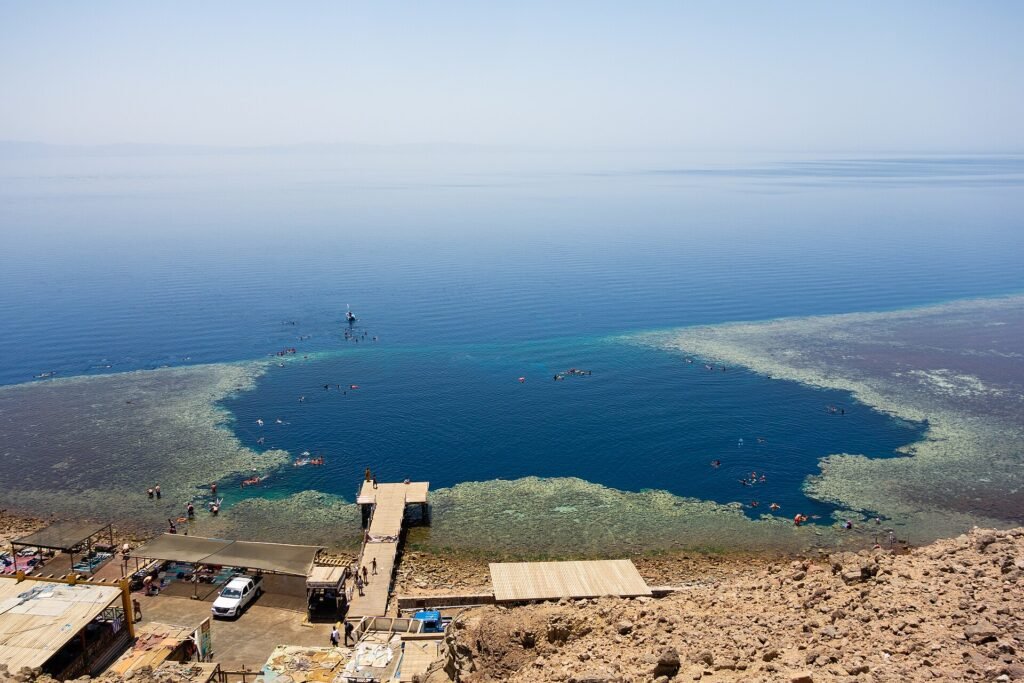
Dahab diving is mostly shore diving. The reef starts a few metres from the beach, so on most dives you kit up, walk into the water and swim straight onto the reef, with no boat. The best-known sites are the Lighthouse and Eel Garden in town, the Canyon and the Blue Hole to the north, and Ras Abu Galum and Gabr el Bint, which you usually reach by boat. This guide covers which sites suit which level, how the certification courses work, how to choose a dive centre, and how to fit diving around Mount Sinai and your flight home.
One thing to be clear about first: Dahab Go runs day trips, including snorkelling and boat trips, but no scuba diving, and it does not run dive courses or a dive centre. Our day trips are useful for the days you are not diving, or for travel companions who do not dive. For a day at the Blue Hole without scuba, see the Blue Hole, Abu Galum and Blue Lagoon snorkelling trip; on the trip page you can check the time, what’s included and the current price, and book there on WhatsApp.
Dahab diving at a glance
The coast around Dahab runs roughly north to south, with the town in the middle. Most sites are reached by car or pickup truck from town, and a few are reached only by boat. Depths below are the ranges published by dive-site guides; each centre sets its own limits on the day, so check before you go.
| Site | Area | Access | Depth range | Usual level |
|---|---|---|---|---|
| Lighthouse | Town | Shore, a short walk from the dive centres | 0 to 30 m | Beginners and training dives |
| Eel Garden | Town | Shore, cross the reef top first | 0 to 30 m | All levels to intermediate; calm sea and high tide only |
| The Islands | Town | Shore, through a short crack in the reef | 0 to 20 m | Intermediate |
| The Canyon | North of town | Shore, through a shallow lagoon | Canyon section about 18 to 30 m | Advanced certification |
| Bells to Blue Hole | About 10 km north of town | Shore | Down to about 30 m | 30-metre (Advanced) certification |
| Ras Abu Galum | North of the Blue Hole, no road | Boat from the Blue Hole area, or camel | 0 to 30 m | Intermediate; conditions decide |
| Gabr el Bint | South of Dahab, no road | Boat only | 0 to 30 m | Intermediate |
How shore diving in Dahab works
A typical dive day starts at the dive centre. You check in, show your certification card, fill in the paperwork and get fitted for gear. For sites in town, such as the Lighthouse, you then walk a few metres to the water. For sites further north, such as the Canyon and the Blue Hole, the centre drives you and the gear up the coast in a pickup truck, and you kit up on the shore.
Shore entries in Dahab often begin with a short swim over a shallow reef plate or lagoon before you descend. At Eel Garden you cross the reef top to reach a narrow lagoon, and at the Canyon you swim across a shallow lagoon first. This is one reason centres care about tide and wind: a shallow entry that is easy at high tide can be awkward at low tide.
Boat diving exists but is the exception. Gabr el Bint and some southern sites have no road and are reached by day boat. For Ras Abu Galum, divers usually drive to the Blue Hole and take a small speedboat north, a ride of about 20 minutes, though some trips still go by camel along the shore. Times and options change, so check before you go. On a day off from diving, our full-day yacht trip in Dahab keeps you on the water with a snorkel instead of a tank.
Bring your certification card and logbook. In Egypt you need proof of certification from a recognised agency, such as PADI or SSI, to rent gear and dive, and certified divers usually dive with a guide from the centre rather than on their own. Ask the centre how its guided dives work before you book.
Dive sites by level
The sites below are grouped by the level they usually suit. Your centre decides the final plan based on your certification, your logged experience and the conditions that day.
First dives and new divers: the Lighthouse, Eel Garden and the Islands
The Lighthouse is a beginner-level site in town: entries and exits are easy, the bay is usually sheltered from the wind, and there is a buoyancy park for practice. A sandy slope with seagrass leads down past a reef wall and coral pinnacles. The buoyancy park has underwater props and statues, including an elephant made from scrap, at roughly 25 to 30 metres.
The shallow part of the Lighthouse suits all levels. Passing the saddle further along to the area with large fan corals is a different matter: divers are usually asked to hold an Advanced Open Water certification there, because the current is stronger. Sightings reported at the site include seahorses, turtles in summer, morays, rays and crocodilefish on the sand.
Eel Garden is named after the garden eels that live on its bright white sandy slope, and some divers set a camera in the sand to film them. It can only be dived at high tide and in calm conditions, because you cross the reef top and a narrow lagoon to get in. Ratings for this site range from all levels to intermediate, so ask how your centre runs it.
The Islands starts through a short crack in the reef and leads into a maze of coral that takes 20 to 30 minutes to work through, with most of the coral at 7 metres or less. Its published depth range goes to about 20 metres. With shallow coral and a maze to find your way through, it suits divers who are comfortable with their buoyancy.
Advanced divers: the Canyon and Bells to Blue Hole
The Canyon is a crack in the reef north of town, about a 25-minute drive from the centre of Dahab. After the lagoon swim you follow the reef to the canyon entrance at around 15 metres, then descend slowly through the canyon to a sandy floor at about 30 metres. The canyon is a cave with an open ceiling, so there is always direct access to the surface. Dive guides list it as an Advanced Open Water dive, or one you can do as part of the Advanced course.
Bells to Blue Hole is the classic Dahab dive. You kit up at the Blue Hole, walk about 150 metres along the shore to the Bells, and drop through a narrow opening into a chimney that leads out to the open reef wall at around 25 to 28 metres (sources give slightly different figures). You then follow the wall south with the reef on your right shoulder, rising slowly, and finish by crossing the shallow Saddle into the Blue Hole at about 7 metres. Centres take divers with a 30-metre certification on this dive.
On the wall you pass large black corals and overhangs, and there is a known cleaning station at about 18 metres where small fish clean visiting divers. Freedivers train inside the hole. Some guides end the dive by swimming around the edge of the hole, where you can watch them; others cross the hole. Ask your guide which way you will go.
Boat and camel days: Ras Abu Galum and Gabr el Bint
Ras Abu Galum lies about 8 km north of the Blue Hole, inside a protected area that was declared in 1992. There is no road, so most divers go by speedboat from the Blue Hole area. Dive guides describe around six sites there, with coral gardens, pinnacles that act as cleaning stations, and turtles, barracuda and eagle rays. The area is also popular with snorkellers, and our Blue Hole trip reaches it by zodiac for snorkelling, not diving.
Gabr el Bint is south of Dahab and is reached only by boat; check the boat time with your centre before you go. It has steep walls with overhangs on one side and a dense row of large gorgonian fan corals on the other. There is no road there, so far fewer people reach the reef.
The southern reefs
South of town, dive guides list Moray Garden, Golden Blocks, Umm Sid and the Caves, with the Caves about 15 km south of Dahab. Like most Dahab sites they are reached by jeep, and their published depth ranges run to about 30 metres. They are worth asking about if you are staying a week or more and want variety beyond the town and Blue Hole sites.
Blue Hole diving: what you need to know
The Blue Hole is a sinkhole in the reef about 10 km north of town, and its maximum depth is just over 100 metres. On the seaward side there is a tunnel known as the Arch, with its ceiling at about 55 metres (one PADI article gives 65 metres). That is well past the limits of recreational diving: Egypt’s Chamber of Diving and Water Sports (CDWS) sets 40 metres as the maximum recreational depth on air, and only for divers whose training and experience allow it.
Wikipedia notes that the site is reputed to have the most diver fatalities in the world. Tarek Omar, a technical diver from Dahab who has recovered bodies from the hole, estimated in 2012 that more than 130 divers had died there in the previous 15 years, as summarised on Wikipedia. Another source quoted on Wikipedia puts the number as high as 200, and the count includes some snorkelling deaths at the surface. Accounts of these accidents point to divers trying to reach the Arch or the bottom on a single tank of air, divers diving beyond their training, and divers without an experienced guide.
The usual recreational dive is planned to stay clear of those risks. Bells to Blue Hole follows the reef wall and enters the hole over the Saddle at around 7 metres, far above the Arch. The Arch is beyond recreational limits and is a site for trained technical divers and freedivers only. On any Blue Hole dive, keep to the depth your certification and your guide allow.
If you are visiting the Blue Hole to snorkel rather than dive, the surface reef wall is a different experience with its own safety points. Our Blue Hole snorkeling guide covers entry points, currents and what to bring. Entry to the Blue Hole area is a protectorate ticket paid on site in cash; check the current amount before you go.
Learning scuba diving in Dahab: courses and certification
For a first course, the Lighthouse in town gives beginners easy shore entries and a bay that is usually sheltered from the wind. Centres teach courses from training agencies such as PADI and SSI. The table below shows the main entry-level options, using PADI’s published age and depth limits and SSI’s Open Water standards.
| Programme | Minimum age | Maximum depth | What it is |
|---|---|---|---|
| PADI Discover Scuba Diving | 10 | 12 m | A supervised try dive, not a certification |
| PADI Junior Open Water | 10 | 12 m at ages 10 to 11; 18 m at ages 12 to 14 | Ages 10 to 11 dive with a PADI professional or certified parent or guardian; ages 12 to 14 with a certified adult |
| PADI Open Water Diver | 15 (juniors from 10) | 18 m | The full entry-level certification |
| SSI Open Water Diver | 10 | 18 m (12 m for ages 10 to 11) | At least four open water training dives |
| PADI Advanced Open Water (15 and over) | 15 | 30 m | Needed for the Canyon and Bells to Blue Hole |
PADI says you can learn in as little as two to four days, and a 2023 guide to diving in Egypt from Enterprise puts Open Water courses at about four to seven days. Ask the centre how many days to allow and fit the course into the early part of your trip, so the no-fly time at the end (see below) does not cut into it.
Before any course you fill in a diver medical questionnaire. It was developed by the Diver Medical Screen Committee with the Undersea and Hyperbaric Medical Society and DAN. If you answer yes to certain questions, you need a doctor’s approval before you can take part. If you have a health condition, get that approval at home before you travel, rather than finding out at the dive centre.
How to choose a Dahab diving centre
Dahab has many dive centres, and this guide does not recommend any one of them. The checklist below draws on advice from PADI and on how diving is regulated in Egypt. Use it to compare two or three centres before you pay.
- Licence and registration. The Chamber of Diving and Water Sports (CDWS) was set up under the Ministry of Tourism in 2007. Dive operations need to meet an international safety standard for recreational diving services to get an operating licence, and the chamber has published a blacklist of operators in the past. Ask whether the centre is licensed and registered with CDWS.
- Training agency and instructors. Ask which agency the centre teaches for. For PADI, you can check an instructor’s status with PADI’s ProChek tool, and SSI has its own centre locator.
- A guide in the water. Confirm that a guide dives with the group for at least part of every dive, and that the guide speaks a language you understand well.
- Group size. Ask how many divers go with each guide. PADI’s advice is no more than four divers per guide where there is current or drift diving.
- Safety equipment. PADI says every dive boat should carry oxygen, life jackets and first aid. Ask what the centre takes on shore dives too.
- Nearest recompression chamber. The centre should know where the nearest chamber is and have its contact details ready.
- Medical form. A careful centre always asks you to fill in a medical questionnaire, even for a single fun dive.
- Gear condition. Look at the rental gear. Poorly maintained equipment is a reason to walk away.
- What is included. Ask whether transport to the northern sites, full equipment, entry tickets and certification materials are included, or added later.
- Insurance. Some centres in Egypt require proof of dive insurance that covers injury and medical evacuation. Check your own cover before you travel.
- No pressure. Clear answers about training, safety and costs are a good sign. Pressure to book on the spot, or vague answers, are a reason to try somewhere else.
Freediving in Dahab
Dahab is also well known for freediving. The Blue Hole is popular for it because deep water is close to the shore and there is little current inside the hole. Other sites used for freediving include the Lighthouse, where beginners practise skills over a sandy slope, and the Canyon.
Freediving needs its own training; a scuba certification does not cover it. Dahab has several freediving schools offering courses from beginner to advanced, including SSI courses. DAN’s advice on freediving safety is clear: never freedive alone, train with a recognised agency, and keep your buddy close enough to help, because most blackouts happen at the surface or within about 5 metres of it.
If you are a scuba diver at the Blue Hole, give freedivers plenty of room and follow your guide’s route.
Diving, Mount Sinai and flying home: plan the order
Plan the order of your dives, the Mount Sinai trip and your flight home before you book any of them. Going up to altitude too soon after scuba diving, by plane or by road, raises the risk of decompression sickness.
The waiting times
The Divers Alert Network (DAN) guidelines for flying after diving recommend a minimum surface interval of 12 hours after a single no-decompression dive, and 18 hours after repetitive dives or several days of diving. After dives with required decompression stops, the wait should be substantially longer; a DAN article on going to altitude after diving puts it at 24 hours. These are minimums, and DAN notes that waiting longer lowers the risk further.
DAN also says the same intervals apply to driving and hiking up to altitude, for elevations of roughly 600 to 2,400 metres (2,000 to 8,000 feet). That matters in Sinai. The town of St Catherine sits at about 1,586 metres, and the summit of Mount Sinai is 2,285 metres, both inside that range.
How to fit Mount Sinai around your dives
Our Mount Sinai sunrise trip picks you up at 22:00, drives to St Catherine, and climbs through the night to reach the summit for sunrise. A dive in the afternoon followed by a 22:00 pickup does not leave enough time. Plan it one of these ways:
- Hike first, dive later. Do Mount Sinai early in your trip, before your first dive. You are back at the hotel around 11:00 and can rest before diving the next day.
- Leave a no-dive day. If you dive first, count from your last dive to the 22:00 pickup, because the drive itself takes you to altitude: at least 12 hours after a single no-decompression dive, at least 18 hours after several dives or several days of diving, and at least 24 hours after any dive with decompression stops. The simple way to meet this is a full day without diving before the trip.
- Do not stack diving after the climb on the same morning. The night hike is long and tiring; rest before you dive again.
For the climb, the trip includes transfers, a Bedouin guide and the protectorate entry ticket. You need a full Egypt visa, as the free Sinai-only stamp does not cover St Catherine, and warm layers for the summit. Check the time, what’s included and the current price on the trip page, and book there on WhatsApp.
Your flight home
If you fly home from Sharm el-Sheikh or another airport, count back from your flight time: at least 18 hours if you have been diving for several days, and at least 24 hours after any dive with decompression stops. Keep your last day free of diving. That last day is a good time for a desert trip or a gentle sea trip that does not involve scuba. If you notice anything after diving that could be decompression illness, DAN’s advice is to get medical advice rather than fly.
When to dive in Dahab
Dahab diving runs all year. Long-term averages put the sea at about 22 °C in January and February and about 27 °C in July and August, when the air can also be very hot (see Dahab weather by month). SSI’s guide names March to June and September to December as the most comfortable months, and its freediving guide picks out April to June and September to November. These are averages and the sea varies from year to year, so check before you go.
PADI reported visibility of about 30 metres at the Blue Hole on a late-November visit. Wind matters more than the calendar for shore entries: on windy days, sites with shallow entries such as Eel Garden may be off the plan. For month-by-month weather and sea notes, see our guide to the best time to visit Dahab, and ask your centre which wetsuit thickness it recommends for the month you visit.
Reef manners for divers
Many Dahab entries cross shallow reef, so small habits make a difference. The advice below follows the responsible-diving tips published by the US National Oceanic and Atmospheric Administration (NOAA) for its marine sanctuaries.
- Get your buoyancy right. Use the correct weight and check your buoyancy at the start of each dive.
- Secure your gear. Clip hoses, gauges and your spare regulator so nothing drags across the coral.
- Do not touch or stand on coral. Even a light brush with a hand or fin can damage coral, and some corals sting or cut.
- Watch your fins near the bottom. Kicking up sand smothers coral and spoils visibility for everyone behind you.
- Leave gloves in your bag. NOAA advises against wearing gloves in coral areas.
- Do not feed, chase or handle marine life. It stresses the animals and can make some of them aggressive.
If you have not dived for a while, a refresher dive at the Lighthouse is a sensible start before the deeper sites.
Ras Abu Galum has been a protected area since 1992, and entry at the Blue Hole is a protectorate ticket paid on site. Follow your guide’s briefing on where you can enter the water and where you cannot.
Days off the tanks: sea trips for non-divers and rest days
A diving holiday in Dahab usually needs at least one day without diving: before Mount Sinai, before your flight, or simply to rest. Many people also travel with a partner, friends or children who do not dive. These Dahab Go day trips cover that time. None of them involve scuba diving.
- Snorkel the Blue Hole and visit Abu Galum. The Blue Hole and Abu Galum day trip runs 9:00 to 17:00: snorkel the Blue Hole reef wall from the beach, then take a zodiac north to Ras Abu Galum and spend free time at the Blue Lagoon. A guide, transfers and a snorkel mask are included; the protectorate ticket is paid on site.
- A day on a yacht. The Full-Day Yacht trip runs 8:30 to 16:00 with snorkelling and swimming stops and lunch on board. The captain picks the spots on the day by wind and sea.
- Snorkelling and the desert in one. The Three Pools and beach buggy trip runs 11:00 to 17:00: snorkel the shallow lagoons at Three Pools, then drive your own buggy to the Wadi Gnai palm oasis.
- The reef without getting wet. The semi-submarine reef trip runs 13:00 to 15:30, with about 1.5 hours watching coral and fish through windows below deck. It suits children, older travellers and non-swimmers.
On each trip page you can check the time, what’s included and the current price, and book there on WhatsApp. You can see every water-based option on our sea trips page. For shore snorkelling you can do on your own, see our guide to Dahab snorkeling spots; for a lazy day on the sand, see Dahab beaches; and for desert, night and other ideas, see things to do in Dahab.
Trips in this guide
 Blue Hole + Abu Galum + Blue LagoonSnorkel the Blue Hole, then go up the coast to Abu Galum and the Blue Lagoon.See the trip
 Mount Sinai Sunrise + St. CatherineA night hike up Mount Sinai for sunrise, then down past St Catherine’s Monastery.See the trip
 Full-Day Yacht on the Red SeaA full day on a yacht, with swimming and snorkelling over the reef.See the trip
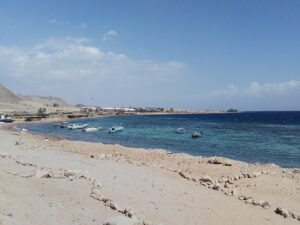 Three Pools + Beach Buggy to Wadi GnaiSnorkel the Three Pools reef, then drive a beach buggy to Wadi Gnai.See the trip
FAQ
Is Dahab good for beginner divers?
Yes, Dahab has sites that suit beginners: the Lighthouse, in town, is rated a beginner site, with easy shore entries and a bay that is usually sheltered from the wind. PADI Discover Scuba Diving lets you try diving from age 10, to a maximum of 12 metres, without a certification. The Open Water course takes you to 18 metres. Leave the Canyon and Bells to Blue Hole until you hold an Advanced certification.
Can you dive the Blue Hole as a beginner?
Not the usual Bells to Blue Hole dive. Dive centres take divers with a 30-metre certification, such as Advanced Open Water, because the route drops through a chimney to around 25 to 28 metres. Beginners can snorkel the reef wall at the surface instead. The Arch, at about 55 metres or deeper, is beyond recreational limits for every certification level and is only for trained technical divers and freedivers.
How long should I wait after diving before climbing Mount Sinai?
Wait at least 12 hours after a single no-decompression dive, 18 hours after several dives or days of diving, and 24 hours after dives with decompression stops, counted to the 22:00 pickup, because the drive takes you to altitude. DAN applies these minimums to driving and hiking as well as flying, and St Catherine (about 1,586 m) and the summit (2,285 m) are in that range. Or simply climb Mount Sinai before your first dive.
How long after diving can I fly home from Sinai?
DAN recommends a minimum of 12 hours after a single no-decompression dive and 18 hours after multiple dives or multiple days of diving. After dives with required decompression stops, wait substantially longer; DAN’s altitude guidance gives 24 hours. If you have dived on several days, plan on at least 18 hours and keep your last day for non-diving trips. If you have any symptoms after diving, get medical advice before flying.
Do I need dive insurance to dive in Dahab?
Some centres in Egypt require it, and it is sensible to have it anyway. Those centres ask for proof of dive insurance that covers diving injury and medical evacuation, on top of normal travel insurance, before your first dive. Check if your travel policy covers scuba diving and to what depth, and ask the centre what proof it needs before you arrive.
Does Dahab Go run scuba diving trips?
No. Dahab Go runs day trips, including snorkelling and boat trips, but no scuba diving; it does not offer scuba dives, courses or dive centre services. For Dahab diving, book with a licensed dive centre using the checklist above. Dahab Go trips fit around your dives: the Blue Hole and Abu Galum snorkelling trip, the Full-Day Yacht, Three Pools with beach buggies, and the semi-submarine for non-swimmers.
More Dahab guides
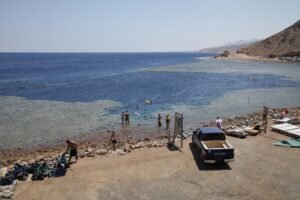 Blue Hole snorkeling guideHow deep it is, where to swim and how to stay safe on the reef wall.Read the guide
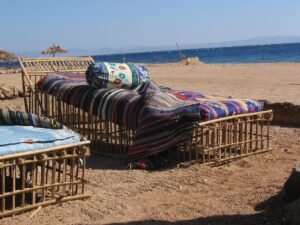 Dahab beachesSandy or reef-edge, calm or windy: which beach suits your day and how to reach it.Read the guide
Photo credits
- The Blue Hole in Dahab seen from the cliff above: a dark blue circle in the reef, with the beach and jetties below — Petar Milošević, CC BY-SA 4.0
- The Three Pools snorkelling spot south of Dahab, with boats on the shore — Hagar Magdy, CC BY-SA 4.0
- Snorkellers on the reef at the Blue Hole beach in Dahab — Grand Parc – Bordeaux, France, CC BY-SA 2.0
- Bedouin cushions and low seats on the beach in Dahab — jay8085, CC BY 2.0